
Reviewed · KRAKOW JEWISH QUARTER TOURS
Full Bike Tour – the Old Town, Jewish Qtr & the Ghetto NEW BIKES
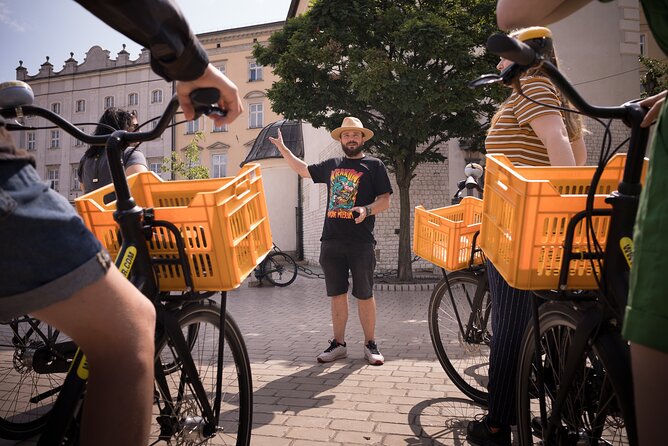
Krakow’s history stretches well beyond its postcard-perfect Main Market Square. This bike tour links the medieval center with Kazimierz, the former Jewish district, and the sites tied to the wartime ghetto, giving you a useful sense of how the city’s neighborhoods fit together.
I like two things here: you cover a lot of ground without a hard ride, and a local guide turns landmarks into stories rather than a checklist. Guides such as Thomas, Chris and Alex have been praised for their warmth and clear explanations.
One thing to weigh: the stops are brief, and the tour is about seeing the city from the outside, not going into museums or taking photos at every landmark. If you want a leisurely visit inside the sights, plan extra time afterward.
- A broad route: Old Town, Wawel Hill, Kazimierz, the former ghetto, Planty Park and the medieval fortifications.
- A manageable ride: The route is described as mostly flat, and many riders find it easy even without strong cycling fitness.
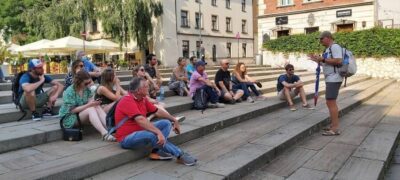
- A personal guide: English-language guides share local history, legends and context, with time for questions.
- A small group: The maximum is 15 people, which helps keep the ride and conversation manageable.
- A practical price: At $35.07, bike use and a local guide are included; entry tickets, food and drinks are not.
- A good first-day choice: The route offers a quick orientation and ideas for places to revisit on foot.
A city ride that connects more than landmarks
Krakow’s center is compact, but its story does not stop at the Main Market Square. This route uses a bicycle to connect the Old Town’s medieval core with Wawel Hill, Kazimierz and the former ghetto area. That makes it especially useful if you have limited time or want to understand the city’s shape before exploring on your own.
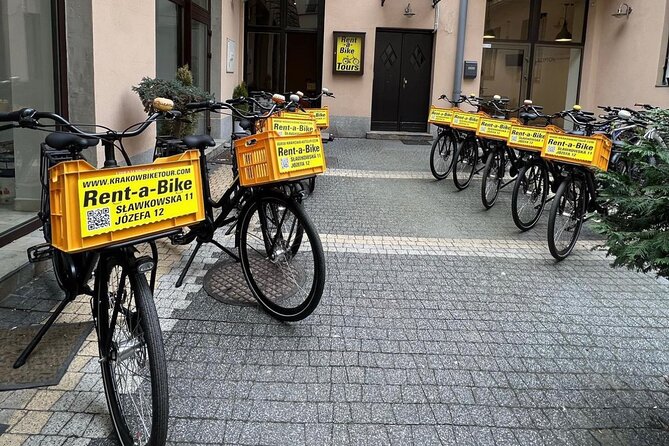
You meet at KrakowBikeTour.com’s Old Town shop at Sławkowska 11. Staff help you choose a bike and offer instructions if needed. There is also a toilet at the starting point, a small but handy detail before a ride lasting about three to four hours.
The tour is offered in English and caps the group at 15. It is not a private ride, but the limit gives the guide a chance to keep the group together and respond to questions. The experience ends back at the same meeting point, so you do not need to plan a separate trip back.
Main Market Square, where the city’s stories begin
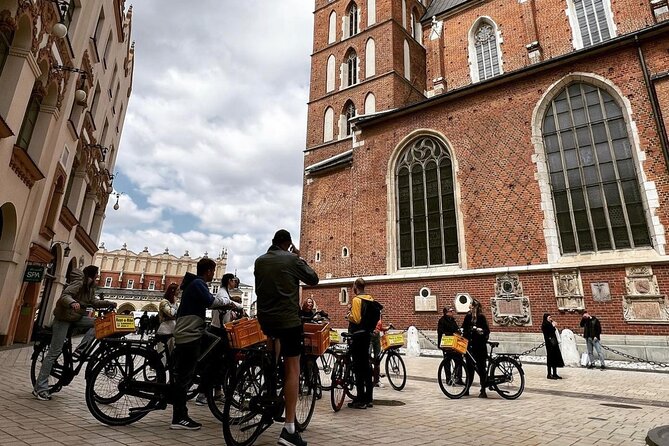
The first major stop is Stare Miasto, Krakow’s Old Town, with its immense medieval Main Market Square. You see the Cloth Hall, the Town Hall Tower and St. Mary’s Basilica, the landmarks that give the square its familiar outline.
The guide introduces the square’s role in medieval trade and shares the story of the trumpeter. That context is more useful than simply learning the names of the buildings: it helps explain why this open space became such a central part of city life. The stop is listed at about 15 minutes, so expect an introduction rather than time to explore each building or go inside.
A bike is useful here because it lets you reach several areas in one outing, but the historic center is still a place to look around carefully and follow your guide’s instructions. If you want close-up photos or a longer look at the basilica, return on foot later. This tour moves on to cover the wider city.
More Jewish heritage tours around Krakow:
- Krakow: Schindler’s Factory & Ghetto Guided Tour
★ 4.7 · 1,694 reviews - Krakow: Jewish Quarter and Former Ghetto Tour
★ 4.9 · 1,441 reviews - Krakow: Bike Tour of Old Town, Jewish Quarter and the Ghetto
★ 4.9 · 1,155 reviews
Collegium Maius and the Wawel stories
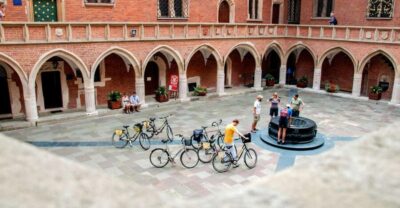
At Collegium Maius, the tour pauses at the Gothic home of the Jagiellonian University, described as Poland’s oldest university. Copernicus studied there, a detail that makes the building more than an impressive façade. The stop gives you a short introduction to one of Krakow’s important academic landmarks.
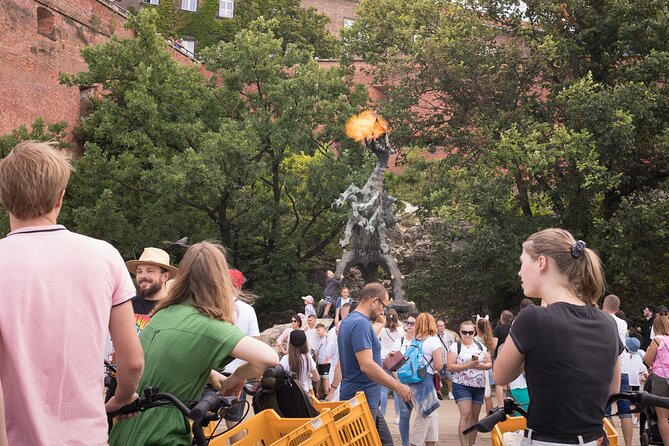
Next comes the Monument of the Wawel Dragon and its local legend: a monster said to have terrorized the city, and a clever craftsman who defeated it by trickery. It is a lighter story in a route that later turns to painful events, and a good example of how the guide mixes folklore with history.
At Wawel Hill, you hear about the castle’s role as the seat of Polish kings. The stop is brief, and admission to the castle is not included. You should treat this as an orientation to the hill and its place in Poland’s past, not as a castle tour. If you want to see the interiors, allow separate time and arrange that visit independently.
A scenic cycle between the center and Kazimierz
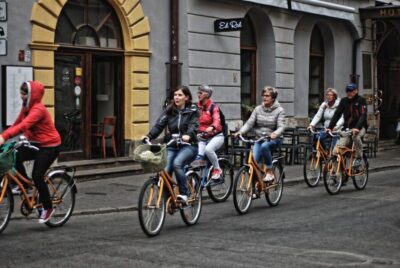
Between major stops, the route uses Krakow’s bike lanes, including a stretch described for its panoramic views and pleasant cycling path. The ride itself is part of the experience: you get a sense of how the central districts connect, rather than moving between them by car or staying within walking distance of the square.
The route is described as mostly flat, and several participants have found the cycling easy. You do not need to be especially fit, but you should be comfortable riding a bicycle and spending several hours out. The group pauses regularly for explanations, so this is not a fast-paced workout.
Bikes are included, and the company says it maintains them. Feedback on their condition has not been entirely uniform, however. Many riders describe the bikes as comfortable and sturdy, while one found the quality less impressive. If a bike feels wrong when you are being fitted, say so before setting off.
Rain ponchos are available if needed. The tour depends on good weather, so poor conditions may lead to a different date or a refund. Pack for the forecast, and remember that even a gentle ride feels less pleasant in cold rain.
Kazimierz, from Jewish community to local hangouts
Kazimierz was once the heart of Krakow’s Jewish community. Today it is also known for galleries, cafés and local spots, and the tour offers a brief look at both its past and its present. This shift is one reason the district feels different from the grand, formal center.
At the area’s Market Square, the guide points out its earlier role as a kosher meat market and its present-day association with zapiekanka, a toasted baguette topped like a small pizza. The stop links food and daily life to the district’s changing character. It is an introduction, not a meal break, so bring your own snack or plan to come back and try something afterward.
Szeroka Street was once among the most prestigious streets in the Jewish quarter and also appeared extensively as a film location in Schindler’s List. The film connection is part of the site’s modern story, but the guide’s historical context helps keep the street from being reduced to a movie backdrop.
With roughly 15 minutes at each of these stops, you have time to listen and look around, but not to linger at every doorway. One useful tip from a rider was to look closely at the doorway at number 11. If small architectural details interest you, keep your eyes open as the group moves through the district.
More Old Town tours around Krakow:
- Old Town Krakow & Wawel Castle Walking Tour
★ 5.0 · 1,508 reviews - Krakow: The Old Town Walking Tour
★ 4.8 · 794 reviews - Krakow: Old Town Guided Segway Tour
★ 4.7 · 756 reviews - Kraków: Old Town & Wawel Castle Walking Tour in English
★ 4.8 · 532 reviews
The former ghetto and Schindler’s factory
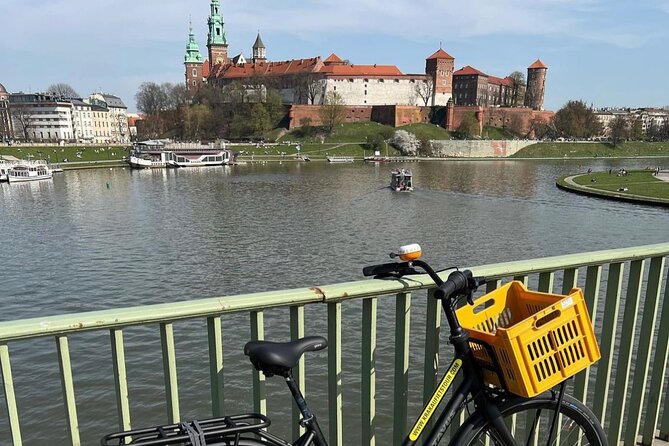
The route then reaches Plac Bohaterów Getta, a memorial to the victims of the Jewish ghetto. The Pharmacy Under the Eagle is also identified here. These are weightier stops than the earlier legends and royal stories, and the guide’s explanations provide a frame for what you are seeing.
This portion of the ride can be moving. The tour gives a short account at the memorial, but it cannot replace a longer visit to sites connected with the Holocaust. If you want more time for reflection, or to explore the pharmacy or nearby places in depth, return later at your own pace.
The next stop is Oskar Schindler’s enamel factory, where he saved more than 1,000 people during the Second World War. Admission is not included, and the stop should not be confused with a visit inside the museum. The tour brings you to the site and gives you historical context; plan a separate visit if you want to see the exhibits.
For many people, this is an important reason to choose the route. You see how Kazimierz and the former ghetto relate to the factory, rather than treating each location as a separate pin on a map. Still, the short stop means you will want another visit if this part of Krakow’s history is a priority.
Planty Park, the Barbican and St. Florian’s Gate
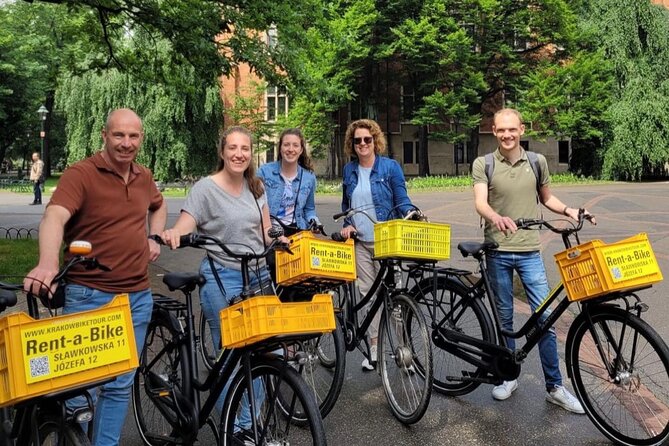
After the more solemn stops, the ride passes through Planty Park, the green belt around the Old Town. The ten-minute pause offers a change of pace and a glimpse of the route that traces the historic center’s edge.
The final landmarks include the Barbican, a remnant of Krakow’s medieval fortifications, and St. Florian’s Gate, once the city’s main entrance. These stops bring the route back toward the Old Town and help you understand how the city was protected and entered in earlier centuries.
The Barbican stop is listed without admission, so expect to see the exterior rather than visit a museum. St. Florian’s Gate is another short stop, useful for orientation and photos, but not a long guided visit. The tour then returns to the original shop.
What the price includes, and what it does not
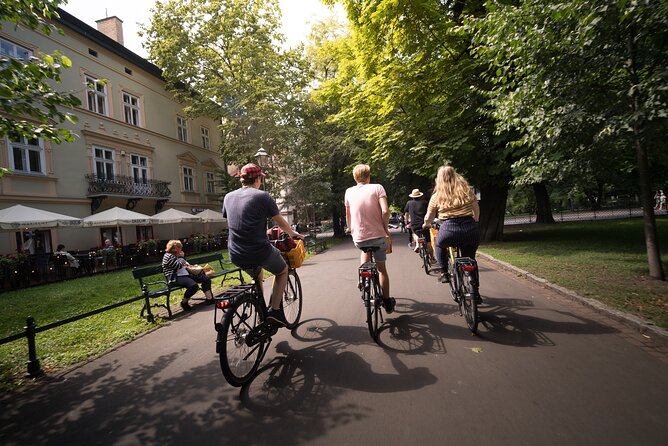
At $35.07 per person, the price includes the bicycle, a local guide, local taxes and a rain poncho when needed. For a three- to four-hour city ride that covers several districts, that is a practical way to get oriented without arranging transport between each area.
The main value is not the bike alone. It is the combination of distance and explanation: you see places outside the central square and hear how medieval trade, university life, Jewish history and the wartime period fit into Krakow’s story. The guide-led format also gives you a chance to ask questions and collect suggestions for later.
Food and drinks are not included, and neither are entry tickets. This matters most at Wawel Castle and Schindler’s factory. If you want to go inside either site, budget for a separate visit and allow enough time beyond the bike tour. The activity itself is a broad introduction, not an all-in-one museum day.
The booking price is worth it if you value a local guide and want to cover more ground than you could comfortably walk in the same time. It is less useful if you mainly want long, unhurried stops or a ride without historical commentary.
Who will get the most from this ride
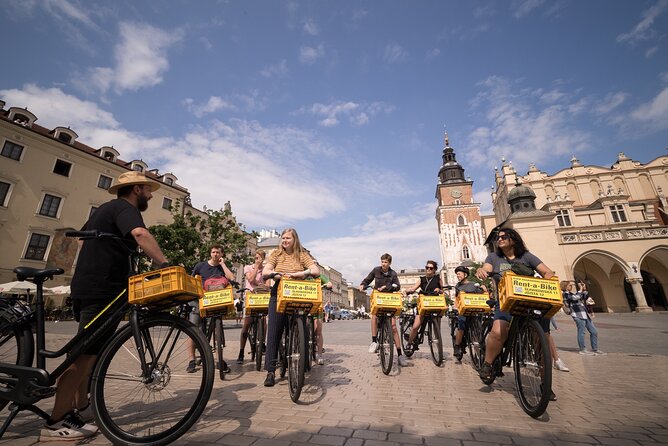
I would choose this tour early in a Krakow stay. The route gives you a mental map of the Old Town, Kazimierz and the former ghetto, while the guide can point you toward places worth revisiting. Several guides, including Thomas, Chris or Christopher, Alex, Michael and Krzysztof, have been praised for their engaging explanations and friendly approach. The specific guide is not guaranteed.
This is a good fit if you like cycling, want an active way to see the city and prefer stories to an audio guide. The ride is described as easy and mostly flat, but you still need to be comfortable on a bike. Children must be accompanied by an adult, and most people can participate.
It is not the best choice if you dislike group rides, need long photo stops, or want to enter every site as part of the outing. One rider wished for more time to take pictures while listening; the company’s approach is built around conversation with a live guide, not an audio track. You can take photos during breaks, but the pace is designed to keep moving.
Should you book the Krakow bike tour?
Book it if you want an active, affordable first look at Krakow and are happy with short stops, outdoor views and a guide-led overview. The broad route, manageable cycling and strong emphasis on local stories make it a sensible way to connect the Old Town with Kazimierz and the former ghetto.
Skip it, or pair it with independent visits, if your main goal is to spend hours inside museums or photograph every landmark at leisure. For the best balance, ride first, note the places you want to revisit, then return on foot to the sites that deserve more time.
FAQ
How long does the bike tour take?
The tour lasts about three to four hours.
Where does the tour start and end?
It starts at KrakowBikeTour.com’s Old Town shop at Sławkowska 11 and ends back at the same meeting point.
What is included in the price?
The price includes a bicycle, a local guide, local taxes and a rain poncho if needed.
Are entry tickets included?
No. Admission is not included for Wawel Royal Castle or Schindler’s factory, and the tour does not include food or drinks.
What language is the tour offered in?
The tour is offered in English.
How large is the group?
The maximum group size is 15 people.
Can children take part?
Yes. Children must be accompanied by an adult.
More bike tours around Krakow
- Complete Cracow Bike Tour (small group of maximum 15 people!)
★ 5.0 · 1,322 reviews - Highlights of Krakow Bike Tour – Small group
★ 5.0 · 662 reviews - Krakow: Bike Tour of the Old Town, Kazimierz, and the Ghetto
★ 4.9 · 350 reviews - Hidden Krakow Bike Tour
★ 5.0 · 275 reviews
Newly listed around Krakow
- Private Krakow to or from Airport Transfer★ 5.0 · 17 reviews
- Private Airport Transfer from/to Krakow Balice Airport★ 5.0 · 124 reviews
- Private Full-Day Zakopane and Thermal Baths Tour from Krakow★ 5.0 · 27 reviews
- Krakow: Polish Aviation Museum – Skip the Line Ticket★ 4.5 · 13 reviews
- Private Guided Walking Tour in Krakow Wine Bars★ 5.0 · 16 reviews
- Pierogi Cooking Class: Mastering the Art of Polish Dumplings★ 5.0 · 129 reviews
- Polish Countryside and Tyniec Abbey Bike Tour from Krakow★ 5.0 · 37 reviews
- Krakow Jewish District and Ghetto Guided Tour in a Small Group★ 5.0 · 12 reviews
Krakow Jewish Quarter Tours, compared.

Bike Tour of Old Town, Jewish Quarter and the Ghetto
Read our review →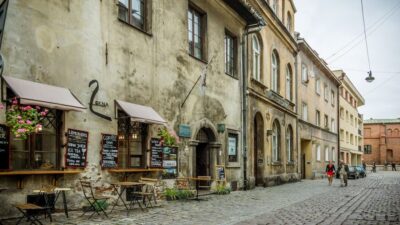
Bike Tour of the Old Town, Kazimierz, and the Ghetto
Read our review →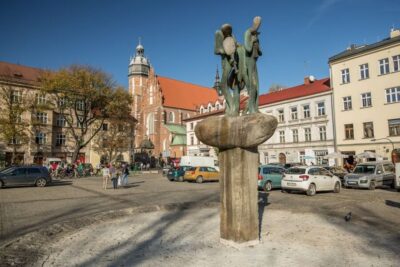
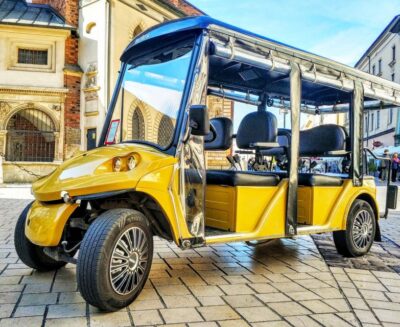
Jewish Quarter and Ghetto Electric Golf Cart Tour
Read our review →
Browse the lists this tour appears in